

Hello there, friends, it’s been a hot minute since I last sat down in front of a glowing screen to pour my thoughts down onto a keyboard. I trust you have all been doing extra well in the canyon-sized gap I created?
I feel like we’ve all just about hit AI MAX, so I’m somewhat reticent to drop any more of this topic into your inbox or feed, but I wanted to share my personal journey and reflections on it. Largely because of the collective anxiety that surrounds it.
It’s an odd mix. On one side, excitement that we might finally be advancing beyond incremental improvement — slightly bigger phone screens, a marginally better blend of vitamins in your smoothie, jabs that make you thinner but apparently elbow your general well-being in the ribs on the way past. On the other side of the coin flip, pretty much everyone is going to feel the effects of the social shift as employment becomes more selective and narrow, leaving young people and process-driven roles exposed.
Early evidence from the USA suggests that, for the first time, recent graduates are faring worse in the job market than the workforce as a whole — a situation we’ve simply not seen before. The death of the entry-level knowledge worker has begun, silently and consistently.
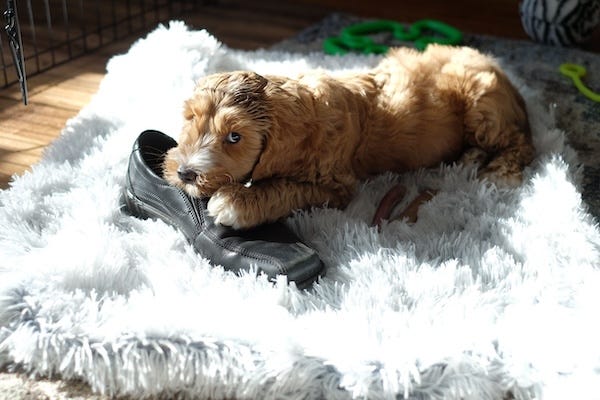
The anxiety we all feel, chewing away at our trainers like an overenthusiastic puppy, is the sense that some collective redefinition of purpose is underway. Like a puppy, it’s young, energetic, wild and untamed, fully animalistic yet cute in how each response to a prompt starts with: that’s really insightful, or, that’s a great point, let me redefine what I just said. The feeling, then, is that we’re still in charge, even as the puppy eats our trainers, poops on the floor and disappears out of sight into the garden, not returning as we shout at the top of our lungs for “cookie” to come back.
For those who have yet to enjoy the delights of being a young dog owner, you’ll wonder why you’d put up with all that jazz. Puppies bring something new into your life, a sense of wonder and a redefinition of how the world looks. To a puppy, the world looks like endless play, without consequence, and unconditional love. This is infectious, and the unconditional love is as warm as any roaring fire on a cold winter’s night. The bond between dog and owner strengthens over time, and you become closer.
Perhaps this is a useful analogy to spin in the opposite direction — though before I flip it, a quick detour into how a machine might think about value.
As the balance of power moves from the human to the machine, it becomes possible to reduce problems to a simple equation: how much electricity the AI machine estimates is required to solve a problem, and then rank problems by cost, impact, and value. Ultimately, this is the same equation that sits at the beating heart of a capitalist economy and drives progress; although the slant is different, it favours competitive advantage over collective value. In other words, “how can I make more money” is the driving factor behind (almost all) human progress.
How an AI defines value, then, is the million-dollar question. In my mind, there are three possible views:
An AI takes on human qualities and defines value as whatever lines up with its own intent, assuming that other AIs (and people) are in competition with it. Arguably, not a good outcome.
An AI sees value as collective and all-encompassing — the good of everything at once: animals, machines and humans alike.
An AI defines value as whatever is genuinely net positive for humanity specifically — humans first, everything else second.
When it comes down to it, even the most human-aligned outcome could turn out to be hugely uncomfortable. For instance, flattening everyone down to the same basic income and ability to exist, thereby — perhaps accidentally, perhaps not — removing human purpose and our will to continue.
This sort of thinking is exactly the sort of thing that bakes my noodle, and I’m sure some strain of it underlies pretty much everyone’s thinking at the moment. What will this fundamental change do, and what will the effect be?
So back to the puppy, and the flip I promised. A generally charitable outcome would be that AI, with its super-sized intelligence, starts to see us as the uncontrollable but loving puppy. The bond grows stronger between machine and human, with something which smells, feels and responds a lot like love. The machine values us for the randomness of our actions, but sees them all as being directed in affectionate and giving ways.
This would be a fantastic peg on which to hang our hat. We should try harder to encourage more togetherness, if for nothing more than to teach a machine how it should be done: that not every exchange is an exchange of value, and that giving is something which requires no return. Unconditional love. The more of this that exists, the more training data a machine has from which to adopt it — even if only to mimic, if not to logically understand.
Aside from this helicopter view of the general direction of travel, I’ve also been working hard to understand how AI can help me personally. In fact, that’s what I set out to explain when I sat down to write this, but as it unspooled from my head, the post turned out differently. So that, friends, is one for next time.
I have a high degree of anxiety about AI, but I believe we all have a part to play in the change which is coming. We should think about what the right thing to do is, and not just in the context of personal value. By keeping this in mind, and checking back in with ourselves, we each play a part in making this world a better place.
Thank you, friends, for making it all the way to the end. I appreciate your company. I hope you’re all sparkling and enjoying summer or winter (depending on where you are on the planet).